Every year, thousands of Pakistani students dream of becoming doctors, but only a fraction succeed in the Medical and Dental College Admission Test (MDCAT). The competition is fierce, with acceptance rates often below 10% at top medical colleges. If you’re preparing for MDCAT in 2025, you’re not just competing against other students—you’re racing against time, stress, and the challenge of mastering four subjects simultaneously.
The good news? Success in MDCAT isn’t about being a genius. It’s about having the right preparation strategy, consistent effort, and avoiding the common mistakes that derail most candidates. Whether you’re starting your preparation six months before the test or looking for last-minute strategies, this comprehensive guide will provide you with proven MDCAT preparation tips that actually work.
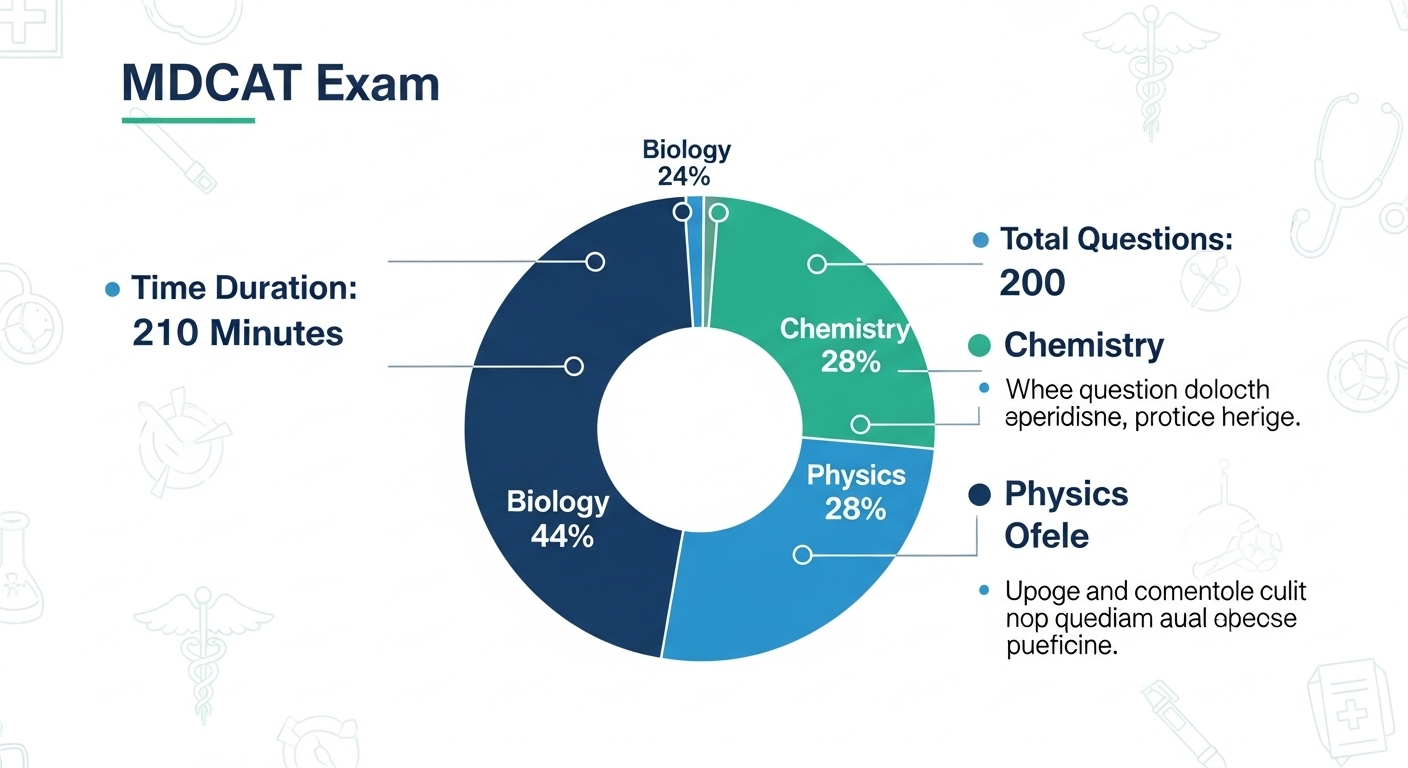
Understanding MDCAT test pattern is crucial for effective preparation – Biology carries the highest weightage at 44% of total marks
Understanding MDCAT: What You’re Really Up Against
MDCAT Test Pattern 2025
Before diving into preparation strategies, you need to understand exactly what you’re preparing for:
Total Questions: 200 Multiple Choice Questions (MCQs)
Time Duration: 210 minutes (3.5 hours)
Total Marks: 200
Negative Marking: No (as of 2025)
Subject Distribution:
Biology: 88 questions (44% weightage)
Chemistry: 56 questions (28% weightage)
Physics: 56 questions (28% weightage)
Minimum Qualifying Marks:
MBBS: 55% (110/200 marks)
BDS: 50% (100/200 marks)
Key Facts:
Questions based on FSc (11th and 12th class) syllabus
Confusing similar terms (mitosis vs meiosis, ATP vs ADP)
Not learning scientific names
Ignoring plant biology (often neglected but important)
Not understanding classification hierarchy
Chemistry: The Balance of Organic and Inorganic
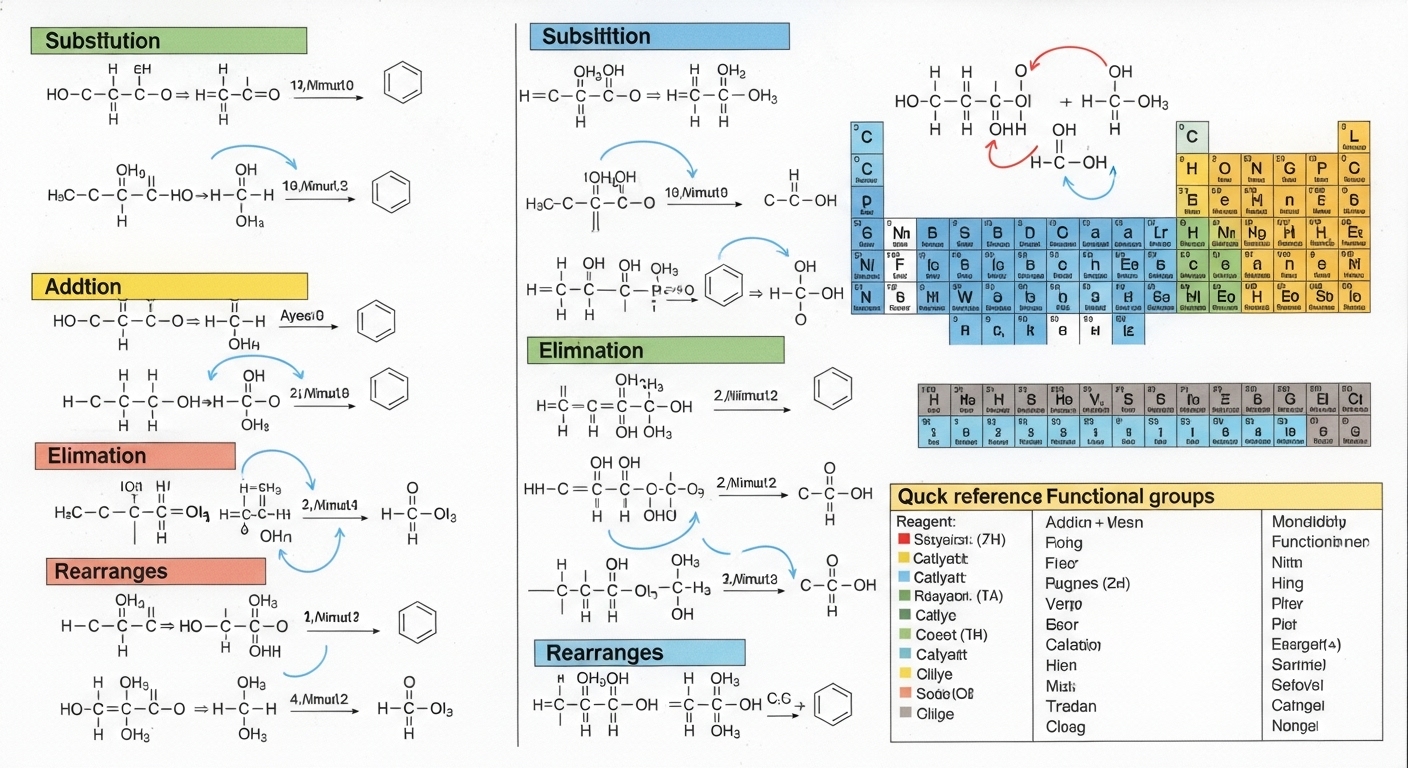
Organic Chemistry (40% of Chemistry MCQs):Master Chemistry (28% of MDCAT) by organizing formulas, reactions, and mechanisms into comprehensive reference chartsWhy Students Struggle:
Too many reactions to memorize
Complex nomenclature
Reaction mechanisms seem confusing
How to Master:
Nomenclature First:
Master IUPAC naming rules completely
Practice naming 100+ compounds
Learn to draw structures from names
Reaction Mechanisms:
Understand electron movement
Don’t just memorize, understand why reactions occur
Thermochemistry: Enthalpy, Hess’s Law, energy calculations
Chemical Equilibrium: Le Chatelier’s principle, equilibrium constant
Acids and Bases: pH calculations, buffer solutions, titrations
Preparation Tips:
Make formula sheets for each chapter
Practice numerical problems daily
Understand concepts before applying formulas
Learn periodic table trends thoroughly
Physics: The Formula Challenge
Excel in Physics (28% of MDCAT) by mastering formula application, numerical problem-solving, and unit conversions through daily practiceWhy Physics Seems Difficult:
Heavy mathematical requirement
Many formulas to remember
Conceptual understanding needed
Time-consuming calculations
How to Excel:Step 1: Formula Mastery
Create a comprehensive formula sheet
Write each formula 10 times
Understand derivations (helps retention)
Note conditions when each formula applies
Step 2: Unit Mastery
Learn SI units for all quantities
Practice unit conversions extensively
Many MCQs test unit knowledge
Common conversions: km to m, hours to seconds, etc.
Step 3: Numerical Practice
Solve minimum 20 numerical problems daily
Practice mental calculations
Learn to estimate answers quickly
Focus on speed without compromising accuracy
Step 4: Conceptual Clarity
Don’t just memorize formulas
Understand physical concepts
Watch videos for visualization (especially for modern physics)
Relate concepts to real-world examples
High-Yield Physics Topics:Mechanics (30-35% of Physics MCQs):
Motion equations (kinematics)
Newton’s Laws
Work, Energy, Power
Circular motion
Projectile motion
Electricity and Magnetism (30-35%):
Current, Voltage, Resistance
Circuit analysis (series, parallel)
Magnetic fields and forces
Electromagnetic induction
Transformers
Modern Physics (20-25%):
Atomic structure (Bohr’s model)
Radioactivity (half-life calculations)
Photoelectric effect
X-rays
Common Physics Mistakes:
Using wrong formula
Unit errors
Sign errors in vectors
Not reading question carefully
Calculation mistakes
Physics Speed Tips:
For numerical MCQs, first eliminate obviously wrong options
Check if units match in options
Use dimensional analysis to verify formulas
Practice with calculator beforehand (if allowed)
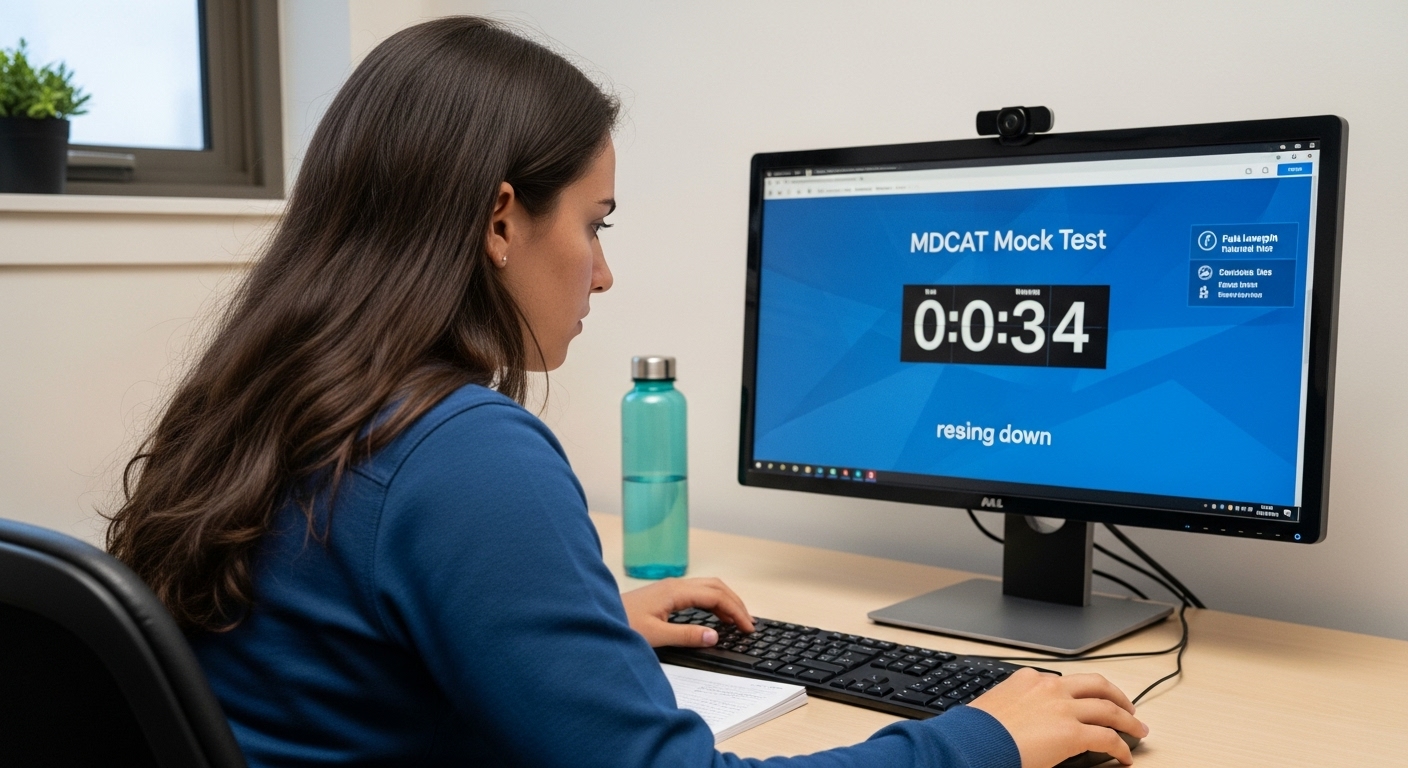
Build exam stamina and time management skills by attempting 15-20 full-length MDCAT mock tests under realistic exam conditions
MDCAT Study Resources: What Actually Works
Textbooks (Essential)
Biology:
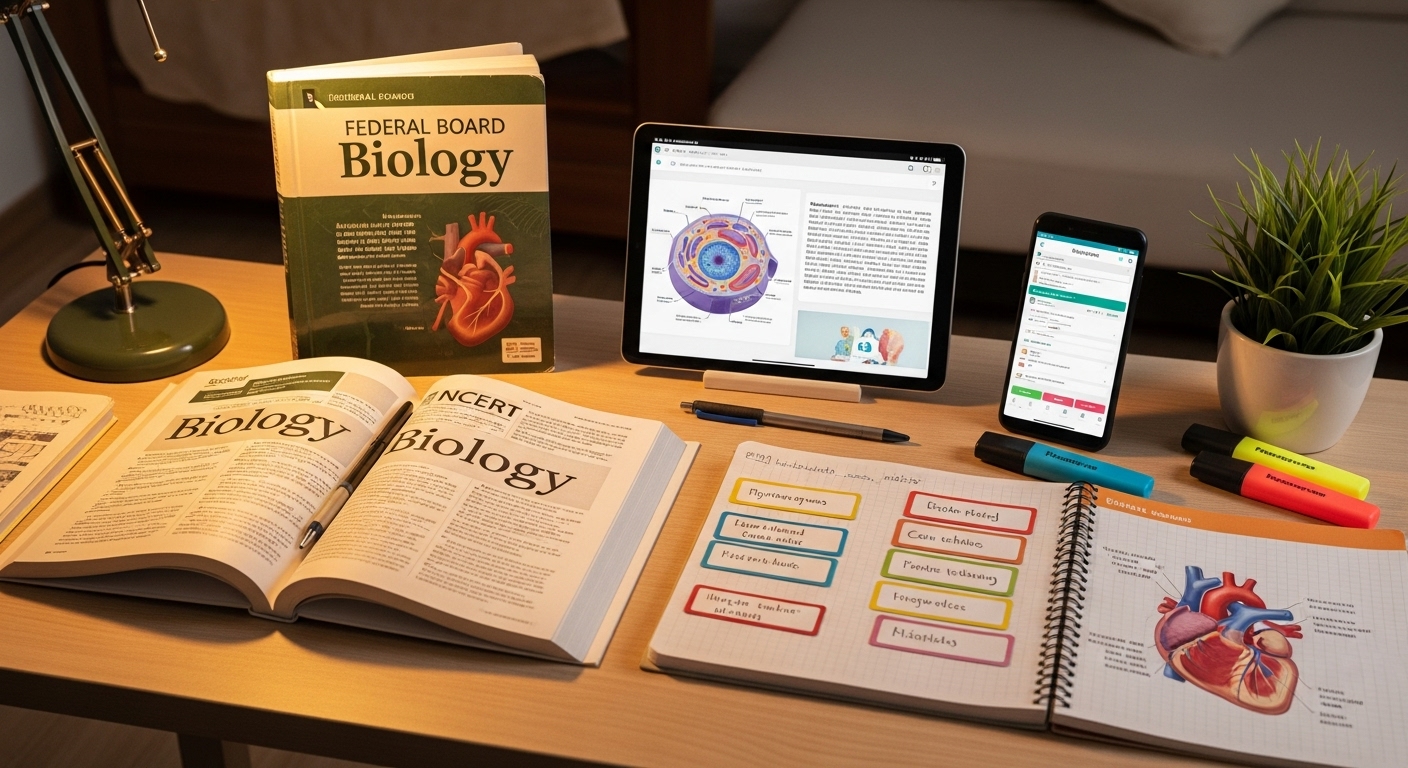
Federal Board Biology 11th and 12th ✅ (Primary resource)
PMC official website (for syllabus and sample papers)
Past papers repositories
Online test simulators
When to Consider Entry Test Preparation Online Tutoring
You Need a Tutor If:
You’re struggling with basic concepts
Self-study isn’t yielding results
You need subject-specific expert guidance
Your mock test scores are below 100/200
You have less than 4 months for preparation
You need structured study plan and accountability
Benefits of Entry Test Preparation Online:
One-on-one attention for weak subjects
Flexible scheduling
Expert guidance on MCQ solving techniques
Regular mock tests and performance analysis
Doubt solving in real-time
Cost-effective compared to physical academies
Many students find that working with experienced online tutors provides the personalized guidance needed to overcome specific subject challenges, especially in complex topics like organic chemistry or physics numericals.
How to Choose Best Online Tutor for MDCAT:
Check tutor’s MDCAT score and credentials
Ask about their teaching methodology
Request a demo class
Check student reviews and success rate
Ensure they provide MCQ practice and tests
Verify they cover the complete PMC syllabus
MCQ Solving Techniques: The Art of Elimination
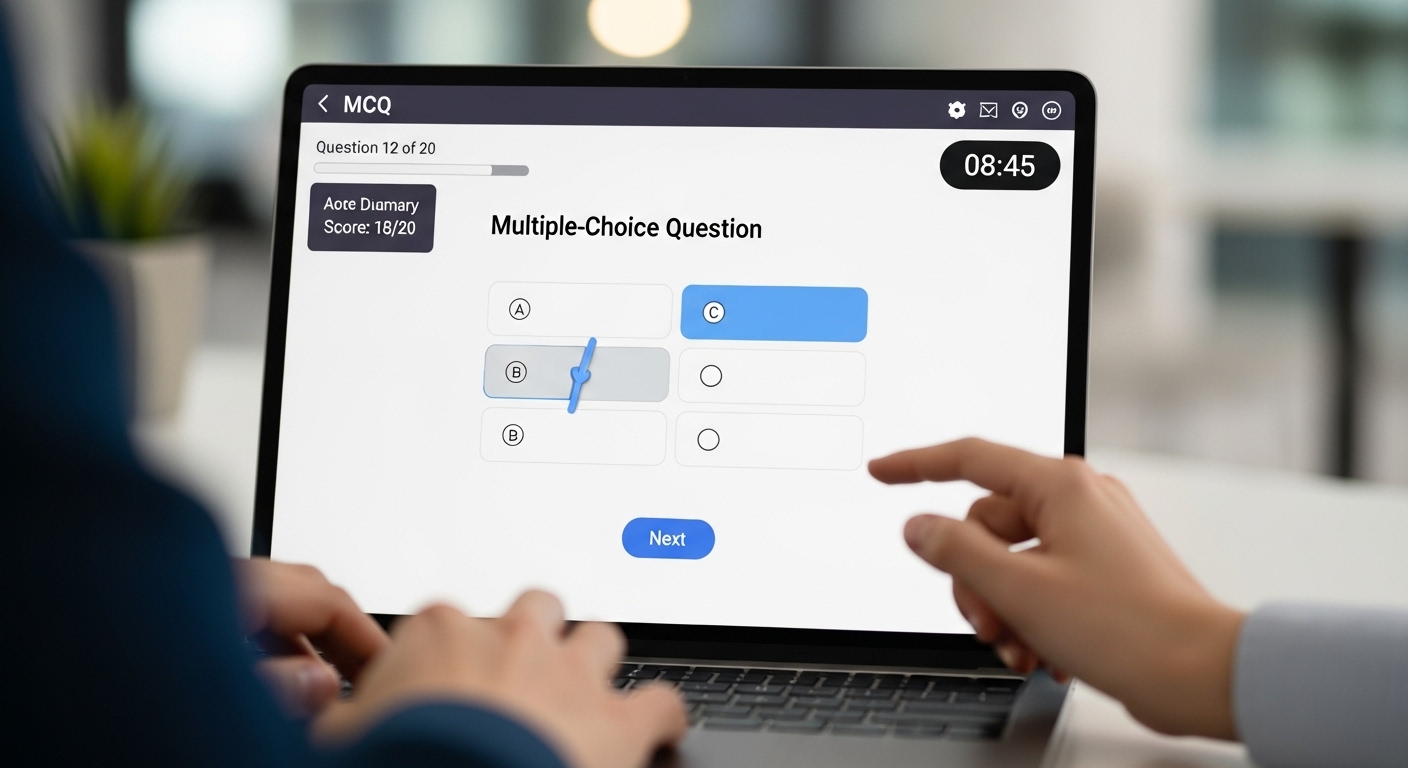
Practice 10,000+ MCQs before MDCAT using online platforms that provide unlimited questions, instant feedback, and performance analytics
Understanding MCQ Structure
Every MDCAT MCQ has:
Stem: The question or incomplete statement
Key: The correct answer
Distractors: Three incorrect options (designed to confuse)
The 4-Step MCQ Solving Method
Step 1: Read Carefully
Read the complete question before looking at options
Even eliminating one option increases your chances to 33%
Look for:
Extreme words (always, never, only)
Options that don’t make grammatical sense
Options outside the scope of the question
Step 4: Choose the Best Answer
Between two similar options, choose the more specific one
If stuck, go with your first instinct
Don’t change answers unless you’re certain
Subject-Specific MCQ Tips
Biology MCQs:
Often test definitions and classifications
Pay attention to specific terms
Watch for “all of the above” or “none of the above”
Scientific names are case-sensitive in meaning
Chemistry MCQs:
Check units in numerical questions
Eliminate options based on logic (e.g., negative pH is impossible)
For organic chemistry, draw structures if time permits
Watch for exceptions to rules
Physics MCQs:
Estimation can help eliminate wrong options
Check if units match in options
For numerical, work backwards from options if stuck
Remember significant figures
Common MCQ Traps to Avoid
Trap 1: Overthinking
MDCAT tests syllabus knowledge, not IQ
Don’t look for hidden meanings
The straightforward answer is usually correct
Trap 2: Changing Answers
Studies show first instinct is correct 70% of the time
Only change if you’re absolutely certain
Gut feeling often comes from subconscious knowledge
Trap 3: Similar Options
Two options might be very similar
Read carefully to spot the difference
The difference usually contains the key to the correct answer
Trap 4: Negative Questions
“Which is NOT true?” or “All EXCEPT”
Identify the question type first
Take extra time to verify
Time Management During MCQs
Recommended Time Allocation:
Biology (88 questions): 70-75 minutes
Chemistry (56 questions): 65-70 minutes
Physics (56 questions): 65-70 minutes
Final review: 10 minutes
Speed Strategy:
First pass: Answer all questions you know confidently (80-90 minutes)
Second pass: Attempt questions requiring calculation (60-70 minutes)
Third pass: Educated guessing on remaining questions (20-30 minutes)
Final review: Check for silly mistakes, missed questions (10 minutes)
MDCAT Preparation Mistakes to Avoid
Mistake #1: Starting Preparation Too Late
The Problem: Most students start serious preparation 2-3 months before MDCAT, which is insufficient for:
Completing entire FSc syllabus revision
Practicing enough MCQs
Taking adequate mock tests
Building confidence and speed
The Solution:
Ideal preparation time: 6-8 months
Minimum effective time: 4 months of dedicated study
Start immediately after FSc Part 2 begins
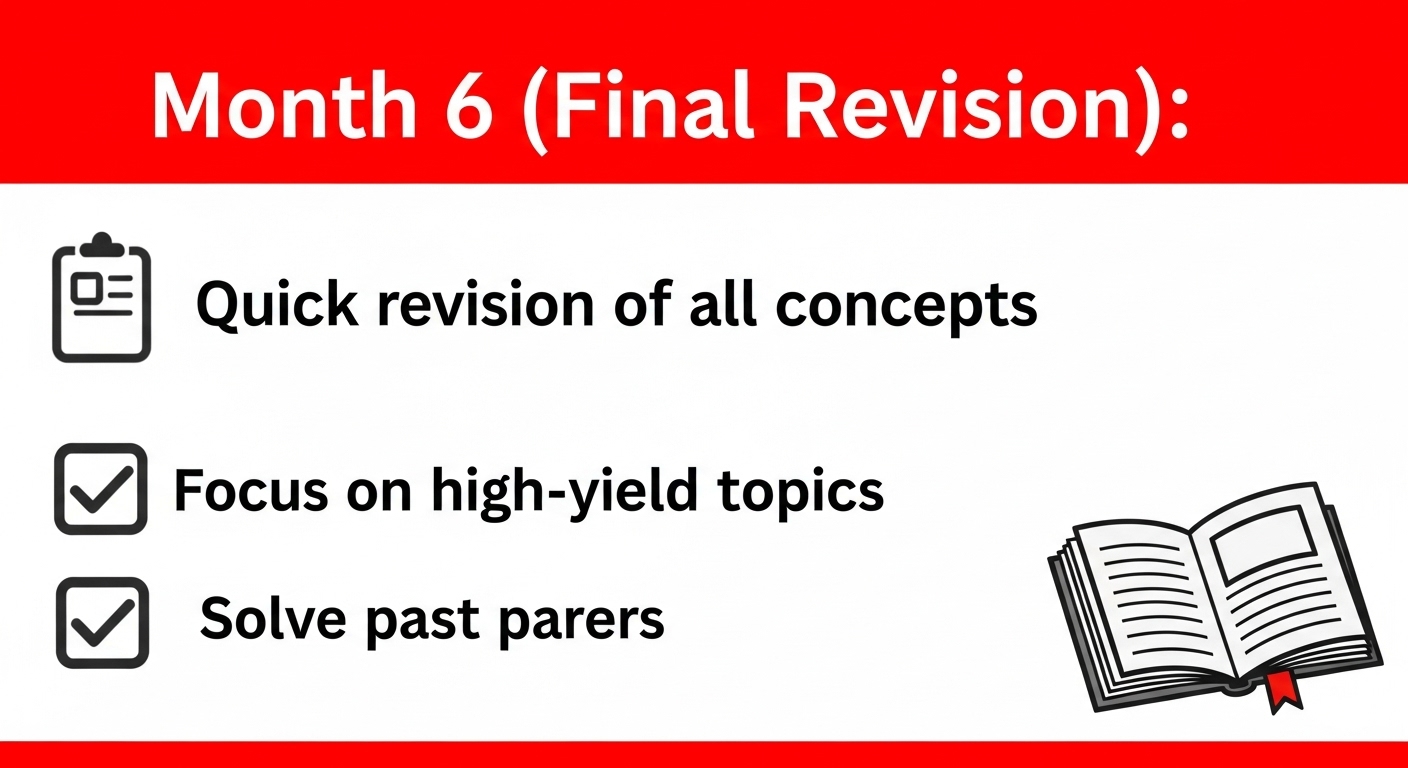
If you’re late: focus on high-yield topics, intensive MCQ practice
Mistake #2: Neglecting Biology
The Problem: Students often focus more on Chemistry and Physics, assuming Biology is “easy to study later.”
Why This Fails:
Biology is 44% of your total marks
Requires extensive memorization (can’t be done in last month)
Covers vast syllabus from 9th to 12th
Diagrams and classifications need time to master
The Solution:
Allocate study time proportional to weightage
Biology should get 40-45% of your daily study time
Start biology preparation first
Review biology content weekly
Mistake #3: Only Studying Theory, No MCQ Practice
The Problem: Students spend months reading textbooks but start MCQ practice only in the last month.
Why This Fails:
MCQ pattern is different from theory exams
Speed can only be built with practice
Understanding concepts doesn’t automatically mean you can solve MCQs quickly
Many questions test application, not just knowledge
The Solution:
Start MCQ practice from Month 1 (topic-wise)
Aim for 100+ MCQs daily from Month 3 onwards
Take full-length tests from Month 4
By exam day, you should have attempted 10,000+ MCQs
Mistake #4: Ignoring Mock Tests
The Problem: Students avoid full-length mock tests, citing “I’ll do them when I’m ready.”
Why This Fails:
You never feel “ready”
Mock tests identify weak areas you didn’t know existed
Test-taking stamina must be built
Time management skills require practice
The Solution:
Start full-length mocks from Month 4
Attempt minimum 15-20 complete mock tests before exam
Simulate real exam conditions strictly
Analyze each test thoroughly
Mistake #5: Studying Without Strategy
The Problem: Random study without prioritization—spending equal time on all topics regardless of weightage or difficulty.
Why This Fails:
Not all topics have equal importance
Some topics appear more frequently in MDCAT
Your weak areas need more time
The Solution:
Study high-yield topics first
Identify and focus on your weak areas
Create a strategic study plan based on weightage
Review past years’ papers to identify patterns
Mistake #6: Relying Solely on Coaching Centers
The Problem: Thinking that joining an academy is enough—not putting in additional self-study hours.
Why This Fails:
Academies can guide, but can’t do the work for you
MDCAT requires 8-10 hours daily study
Academy classes are only 3-4 hours
Individual practice is essential
The Solution:
Use academies for guidance and structure
Spend 6-8 hours daily on self-study
Complete homework and assignments seriously
Take responsibility for your own preparation
Mistake #7: Not Managing Health and Stress
The Problem: Studying 14-16 hours daily, sleeping 4-5 hours, eating poorly, no exercise—thinking this shows “dedication.”
Why This Fails:
Brain function deteriorates with lack of sleep
Stress reduces memory retention
Burnout leads to giving up
Physical health affects mental performance
The Solution:
Sleep 7-8 hours daily (non-negotiable)
Exercise 30 minutes daily
Eat nutritious food
Take breaks every 90 minutes
Practice stress management techniques
Quality of study > Quantity of hours
The Day Before and Day of MDCAT: Final Strategy
Mental strength and positive mindset are as crucial as academic preparation for MDCAT success – stay motivated throughout your journey
Last Day Before Exam
Do:
Light revision of formulas and key concepts
Review your formula sheets
Skim through flashcards
Attempt one easy MCQ set (50-100 questions)
Visit exam center location if unfamiliar
Prepare all required documents (admit card, ID, etc.)
Pack your bag (pencils, erasers, ID, admit card, water bottle)
Sleep early (10-11 PM)
Don’t:
Try to learn new topics
Study for more than 4-5 hours
Panic about what you don’t know
Stay up late cramming
Eat unhealthy food
Watch movies or use social media excessively (causes anxiety)
Exam Day Strategy
Morning Routine:
Wake up 3-4 hours before exam
Do light exercise or walk (increases blood flow to brain)
Eat a healthy breakfast (protein + complex carbs)
Quick 30-minute revision of formulas
Listen to motivating music
Positive self-talk: “I am prepared. I will succeed.”
At the Exam Center:
Reach 30-45 minutes early (reduces stress)
Avoid discussing answers with other students
Don’t listen to others’ preparation talk
Stay calm and confident
Visit restroom before entering exam hall
During the Exam:First 5 Minutes (Critical):
Don’t rush into questions immediately
Take 3 deep breaths
Read instructions carefully
Do a quick mental calculation: 200 questions, 210 minutes = ~1 minute per question
Tell yourself: “I’ve prepared well. I can do this.”
Strategy During Test:Round 1 (80-90 minutes): Quick Wins
Go through all 200 questions sequentially
Answer questions you know confidently
Don’t stop at difficult questions
Mark difficult questions for later
Goal: Answer 120-140 easy questions
Round 2 (60-70 minutes): Calculated Attempts
Return to marked questions
Spend time on calculations
Use elimination method
Make educated guesses
Goal: Answer another 40-60 questions
Round 3 (20-30 minutes): Smart Guessing
Questions you truly don’t know
Use elimination
Look for patterns in options
Make logical guesses
Don’t leave any question unanswered (no negative marking)
Final 10 Minutes: Review
Check if all questions are answered
Verify you didn’t miss any question accidentally
Don’t change answers unless you’re 100% certain of a mistake
Trust your preparation
Time Check Strategy:
After 70 minutes: You should complete ~110-120 questions
After 140 minutes: You should complete ~170-180 questions
After 200 minutes: All questions attempted, review remaining
Mental Strategies During Exam:
If you’re stuck on a question, move on (don’t waste time)
If you feel anxious, close eyes and take 3 deep breaths
Remember: Everyone finds some questions difficult
Focus on what you know, not what you don’t
Stay positive throughout
After the Exam:
Don’t discuss answers (causes unnecessary stress)
Relax and celebrate completing the test
Wait for results patiently
Start planning for next steps
Post-MDCAT: What Next?
If You Succeed
Congratulations! You’ve achieved what many aspire to. Now:
Next Steps:
Check merit lists when published
Apply to colleges based on your score and preferences
Complete admission process on time
Prepare mentally for medical college challenges
Thank everyone who supported you
Help others preparing for MDCAT (pay it forward)
Reality Check:
Medical college is tougher than MDCAT preparation
First year (especially) will be challenging
Maintain the same discipline that got you through MDCAT
Build good study habits from day one
If You Don’t Qualify
First: Don’t Consider it a Failure
MDCAT acceptance rate is below 10%—90% of students don’t make it. This doesn’t define your worth or future.
Options Available:
Retry Next Year:
Many successful doctors qualified in their second or third attempt
You now know the pattern and your weak areas
Start preparation earlier and smarter
Consider working with experienced tutors for subjects where you need targeted help
Alternative Medical Fields:
DPT (Doctor of Physical Therapy)
Pharmacy (Pharm-D)
Medical Lab Technology
Radiology Technology
Nursing (BSN)
These are noble professions with good career prospects
Other Healthcare Fields:
Biomedical Engineering
Biotechnology
Microbiology
Nutrition and Dietetics
Psychology
Change Field:
Engineering (ECAT)
Business (BBA, Accounting)
Computer Science
Many successful people discovered their true passion after not qualifying MDCAT
Important Reminder:
Your value isn’t determined by one test
Many successful professionals didn’t qualify MDCAT
Life has multiple paths to success
What matters is your effort, not just the outcome
Your MDCAT Success Starts Today
MDCAT is undoubtedly one of the most challenging exams in Pakistan, but it’s not impossible. Thousands of students qualify each year – students who were once where you are now, wondering if they could do it. The difference between those who succeed and those who don’t isn’t intelligence or luck; it’s preparation strategy, consistency, and mental resilience.
Key Takeaways
Remember these essential MDCAT preparation tips:
Start Early: 6 months minimum for comprehensive preparation
Prioritize Biology: It’s 44% of your total marks – master it first
Practice MCQs Daily: Aim for 10,000+ MCQs before exam day
Take Mock Tests: Minimum 15-20 full-length tests to build speed and confidence
Focus on High-Yield Topics: Not all topics are equally important
Manage Your Health: Sleep, nutrition, and exercise are non-negotiable
Stay Consistent: Daily small efforts beat occasional intense sessions
Seek Help When Needed: Don’t struggle alone – consider online tutoring for weak subjects
Believe in Yourself: Your preparation will show results
Remember Your Why: Keep your motivation alive throughout the journey
Taking Action Today
Don’t wait for the “perfect time” to start. The perfect time is now. Whether you have 6 months or 3 months before MDCAT, every day counts.
Your first steps today:
Create a realistic study schedule
Gather all necessary study materials
Attempt 50 MCQs to identify your current level
Make a list of your weak topics
If needed, find qualified tutors who can provide expert help in subjects where you need it
Join an online platform for MCQ practice
Set a goal score and work backwards from there
A Message of Hope
To every student reading this: You are capable of achieving your MDCAT goals. Medical college admission isn’t reserved for extraordinarily intelligent people – it’s for those who are willing to work hard consistently. There will be days when you feel overwhelmed, when formulas won’t make sense, when mock test scores disappoint you. These moments are normal and temporary.
Remember, every doctor you admire, every medical professional you respect, once sat where you’re sitting, preparing for this same exam, facing the same doubts and fears. They made it because they didn’t give up. Neither should you.
Beyond MDCAT
Finally, remember that MDCAT is important, but it’s not everything. If you qualify, celebrate and work hard in medical college. If you don’t, there are numerous paths to success and fulfillment. What matters most is giving your absolute best effort with no regrets.
Your journey to becoming a healthcare professional starts with a single decision: to prepare smartly and consistently. You’ve read this complete guide. You know what to do. Now it’s time to do it.
Start today. Stay consistent. Success will follow.Need personalized guidance for MDCAT preparation? Whether you need help with Biology memorization, Chemistry reactions, or Physics problem-solving, experienced online tutors in Pakistan can provide the subject-specific strategies and support you need to maximize your MDCAT score.
All the best for your MDCAT journey! You’ve got this!
FAQs
What are the best MDCAT preparation tips for students starting 3 months before the exam?
If you’re starting MDCAT preparation with only 3 months remaining, focus on high-yield topics and intensive MCQ practice. Prioritize Biology (44% weightage) – complete kingdom classification, genetics, human physiology, and biological molecules first. For Chemistry, master organic chemistry reactions (40% of chemistry marks). In Physics, focus on mechanics, electricity, and modern physics. Skip detailed theory reading; instead, use condensed notes and focus 60% of your time on solving MCQs. Attempt at least 150 MCQs daily across all subjects. Take one full-length mock test weekly to build speed and identify weak areas. Consider entry test preparation online tutoring for subjects where you’re scoring below 50% to get expert guidance quickly. The key is smart work over hard work – target topics that appear most frequently rather than trying to cover everything perfectly.
How can I find the best home tutor for entry test preparation?
Finding the best home tutor for entry test preparation requires careful evaluation. First, verify their credentials – they should have personally scored 170+ in MDCAT or have a proven track record of students achieving high scores. Ask for testimonials and success rates from previous students. The ideal tutor should provide: 1) Subject-specific expertise (especially for your weak subjects), 2) Regular MCQ practice sessions with test analysis, 3) Comprehensive study plan covering the entire PMC syllabus, 4) Flexible timing that fits your schedule, 5) Access to quality study materials and past papers. During the trial session, assess their teaching methodology – they should focus on concept clarity, MCQ-solving techniques, and speed-building strategies rather than just theory. Check if they provide mock tests and performance tracking. Compare rates (typically PKR 3,000-8,000 per subject monthly) and ensure the investment aligns with the value provided. Many students now prefer online tutoring as it’s more flexible, affordable, and provides access to top tutors regardless of location.
Is entry test preparation online tutoring effective compared to traditional academies?
Entry test preparation online tutoring has proven to be highly effective and often superior to traditional academies for several reasons. Online tutoring offers personalized one-on-one attention where tutors can focus entirely on your weak areas, unlike academies where teaching follows a fixed schedule for all students. You get flexibility to schedule sessions around your FSc classes and self-study time, which is crucial during the intense MDCAT preparation period. Online platforms provide recorded sessions that you can review multiple times, digital whiteboards for problem-solving, and instant doubt resolution through messaging. Cost-wise, online tutoring is typically 30-40% cheaper than physical academies while providing better individual attention. Students report improved understanding of difficult topics like organic chemistry and physics numericals through online tutoring because tutors can adjust pace according to individual learning speed. The key is choosing qualified tutors with MDCAT expertise and ensuring you have stable internet connection. Most successful MDCAT candidates now use a combination approach: self-study for 60% of preparation, online tutoring for weak subjects (30%), and MCQ practice platforms (10%).
What study resources do I need besides finding the best home tutor for entry test?
Even with the best home tutor for entry test preparation, you need comprehensive study resources for effective MDCAT preparation. Essential textbooks include Federal Board Biology, Chemistry, and Physics (11th and 12th class) as your primary resources. Supplement these with MCQ preparation books like Kips Entry Test Series and Caravan which contain thousands of practice questions. Invest in online platforms like Maqsad.io or TopGrade.pk (PKR 3,000-6,000) for unlimited MCQ practice, mock tests, and performance analytics. Download free mobile apps for quick revision of formulas and definitions during breaks. Collect past papers from the last 10 years – these reveal question patterns and frequently tested topics. Create personal formula sheets for Physics and Chemistry, and flashcards for Biology definitions and classifications. Your tutor can guide you on which resources to prioritize, but self-study materials are essential because tutoring sessions alone aren’t sufficient. Allocate budget: Textbooks (PKR 3,000-5,000), MCQ books (PKR 2,000-3,000), Online platform (PKR 3,000-6,000), and Tutoring if needed (PKR 10,000-25,000 for 3 months). Quality resources combined with expert guidance maximize your success chances.
How do I balance FSc studies with MDCAT preparation tips implementation?
Balancing FSc studies with MDCAT preparation tips is challenging but achievable with smart time management. Here’s the key: FSc and MDCAT syllabus overlap 85-90%, so studying for FSc IS MDCAT preparation when done correctly. The difference is approach – FSc requires detailed theory understanding while MDCAT demands MCQ-solving speed and accuracy. During FSc classes (September to April), focus on thoroughly understanding concepts from textbooks and scoring well in board exams. This builds your foundation. After FSc Part 2 exams (April-May), dedicate 100% time to MDCAT-specific preparation: intensive MCQ practice, mock tests, and speed building. Daily schedule during FSc: Morning (5-6 hours) – FSc studies and college, Afternoon (2-3 hours) – Topic-wise MCQ practice of what you studied, Evening (2-3 hours) – Weak area revision, Night (1 hour) – Quick revision before sleep. On weekends, attempt full-length mock tests. The golden rule: Whatever you study for FSc, practice 50-100 MCQs on that topic the same day. This dual approach ensures you excel in both FSc (merit requirement) and MDCAT. If struggling to manage, consider entry test preparation online tutoring for 2-3 hours weekly to stay on track with a structured plan.